Go Build Something!
My Life as an Amateur Game Designer
1/24/2026
What crazy projects can we find in Chase's past?
The following is adapted from a powerpoint I made as a potential hackathon hype presentation
The Clickteam Fusion Period
My life as an amateur coder and creator started young.
I always loved playing video games, so that was naturally the first stepping ground for my exploits. In elementary school, I joined an after-school program where we learned to make simple games using templates and sprite packages within Clickteam Fusion. I made a fake Pong, Chocobreak (a clone of Breakout that is Clickteam's flagship demo project), and a battle game that was trying to be Smash Bros., but I ended up just having the characters float in eight directions and shoot stock sprites at each other when I realized I didn't know how to code gravity.
After that program, I decided I would use Clickteam Fusion to make a few games of my own. I had two friends who also liked making trash Youtube-Poop-inspired games. My one friend made a game in Unity where you kick trees akin to Cookie Clicker, and another where you run around 3D Mario worlds such as Peach's Castle and Honeyhive Galaxy as a Shrek model that looked like a Russian Nesting Doll. He also started a racing game where you play as none other than Tingle, the Legend of Zelda side character. We named the unofficial project "Old Rag Development Ventures", after the tallest mountain in Virginia, where we grew up. We hiked the mountain annually with our scout troop.
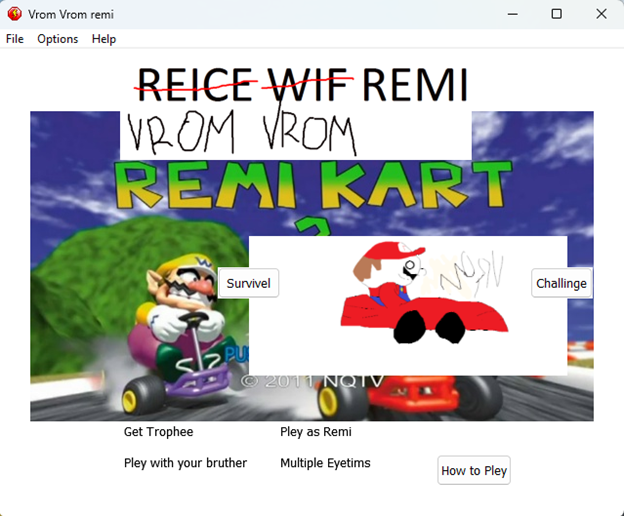
My contributions to the budding game company started with Vrom Vrom Remi, a game inspired by a French Youtube prankster named Remi who dressed up as Mario and went on an escapade in a go-kart while throwing banana peels at cars. By this time, I was able to get the physics working, so the cart stayed on the ground. You played as Remi, and you jumped and moved around the 240x240 box while dodging shells and banana peels that I drew in Microsoft Paint. If you got a Super Star or a Shine (the reflector that Fox McCloud and Falco Lombardi use in Smash Bros.), you became invincible for a few seconds. The final enemy was three pictures of Hillary Clinton that I stole from the internet. If you were able to dodge the onslaught of Hillarys, you won.
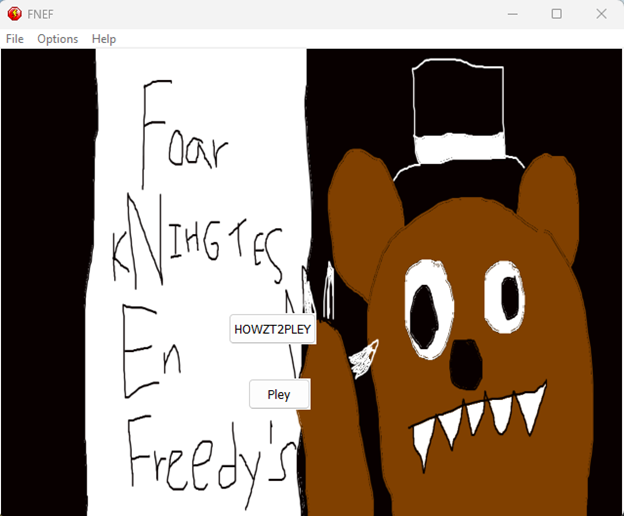
The second game I attempted using Clickteam Fusion was called Foar kNightes En Freedy's, or fnef for short. This, of course, was a satirical version of Five Nights at Freddy's, a popular horror game where you, as a security guard at a pizza restaurant, prevent animatronics from killing you by checking cameras and temporarily closing entry points. I made basic elements of the game, including a map of the restaurant, images of each character approaching in the doorway, and a crude security station that was clearly made using Microsoft Paint. However, I never finished the project, so it remains a template of menus and sprites without any functionality.
The Java Period
I made a few other demo projects using Clickteam Fusion, including a top-down driving game where you avoid obstacles and a sandbox where you can add an increasing amount of boxes. But by the time I got to high school, I was getting comfortable enough with coding that I didn't need a platform like Clickteam Fusion or Scratch to handle logic. For the first three years of high school, I took programming classes using Java, and we had open-ended final projects that allowed me to create some games.
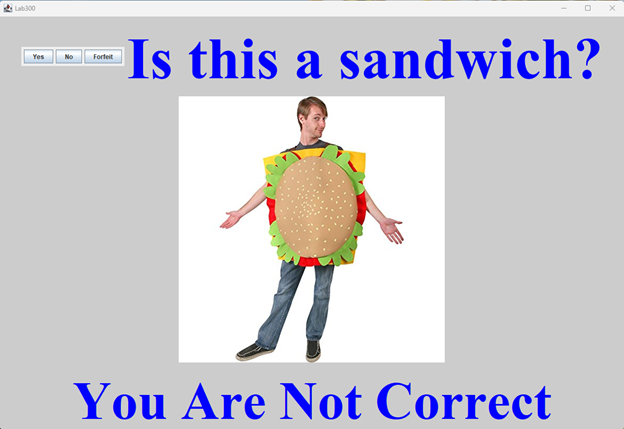
My first Java project was "Sandwich Game". It simply involved displaying an image on the screen, and the user would have to select whether the object in the image was a sandwich. The easy mode contained all sandwiches except for the last object, the medium mode contained a mix of sandwiches and non-sandwiches, and the hard mode contained things that were harder to tell if they were a sandwich (such as a sandwich-looking cake or sandwich-looking shoes).
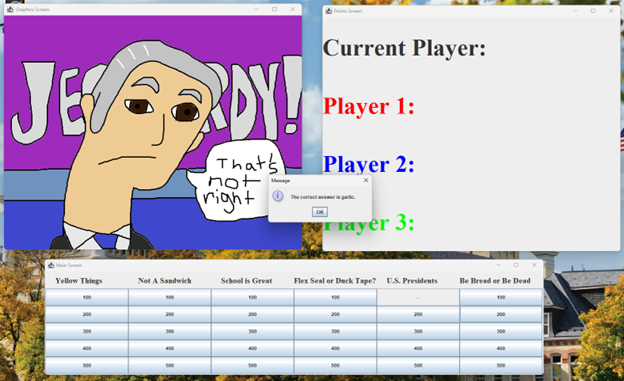
My second Java project was "Jep!", a parody of Jeopardy. The main screen had none other than a Microsoft-Painted Alex Trebek telling you whether or not you got the question right. Players would load in a question pack and alternate to take turns. The questions ranged from obvious to impossible and covered a variety of mundane topics, such as "Yellow Things" and "Flex Seal or Duct Tape?" While the basic Java libraries I used for the graphics were hard to work with, my three-screen approach helped the UI appear better than it did for my other Java projects.
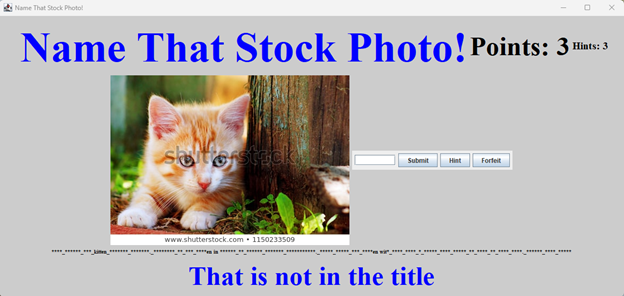
My third Java project was "Name that Stock Photo!". This game required the user to guess words from the title of a stock image. Like with Sandwich Game, I pre-selected each stock image, with titles ranging from short and simplistic to long and verbose.
The Unity Period
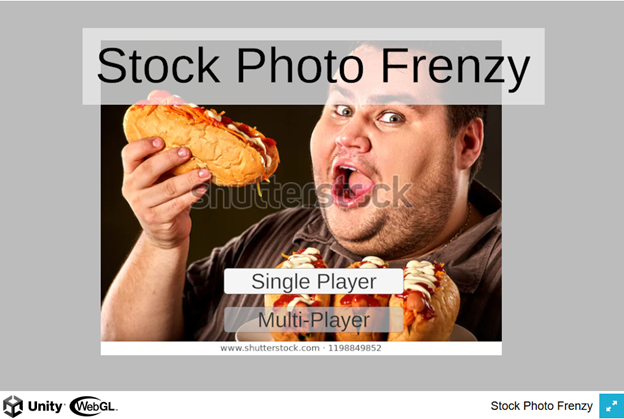
After creating "Name that Stock Photo!", I decided to make a beefier version in Unity that I named "Stock Photo Frenzy". The main addition to the Unity version was that it could pull images from the internet. I had no idea what web scraping was, but that was exactly what I was doing. I used the inspect tool on the browser to find the image url and found some Stack Exchange discussions with the regex code I needed. Learning the Unity library was an arduous task, but it helped me become a better coder and get comfortable with more complex features like coroutines and classes. The gameplay was the same for this version, except for a one-minute timer during each round. I was most proud of the title screen, which had ten pre-selected stock images float across the screen and a gliding animation to move the camera up and down to access the options pane.
The Unity version went through a few iterations. It turns out that companies don't like you scraping their websites and accessing their images for free, so the original web-scraper version ceased to work after a few weeks. I put the project on hold until I got to college and created an updated version during the summer of 2024. By this time, I was able to use ChatGPT to write code snippets, which helped me greatly. This version used the Shutterstock API for photos instead of web scraping. This limited the variety of photos I could pull, but there was still plenty of variation (I doubt anyone will play enough to see all three million photos available through the API). I briefly hosted this version on the web using Vercel, being the first game I have ever shared publicly instead of exclusively to friends.
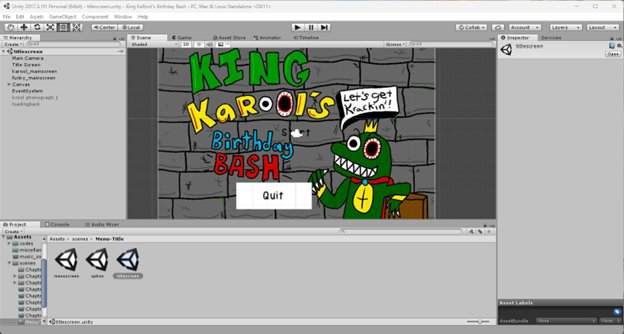
I also had a much bigger project happening in the background, King KaRool's Birthday Bash. This was a fan game centered around King K. Rool of the Donkey Kong franchise, who hosted a birthday party for his nephews but had to compete in minigames when members of the Kong family interrupted the festivities. Minigame concepts included avoiding pellets coughed up by Squawks in Bramble Scramble and avoiding peanuts from Diddy's blasters, among other things. This project suffered from the same challenge that I had with fnef: I liked planning the story and making art, but once I got to the coding part, I had no idea how to implement it! I went from having a handful of minigames to writing scripts for eight different chapters and making sections based on every past Donkey Kong game. But due to my lack of expertise, I ended up only coding a few sections. I never had anything that amounted to a playable level.
Conclusion
In the span of a few years, coding went from copying and pasting snippets from GitHub and comment boards to having an agentic chatbot read your directory and almost instantaneously provide the code you need. I use AI tools for nearly all my coding at this point, and despite frequent use, I am still amazed every time I see coherent code generated to suit my needs.
However, I am also very appreciative that I grew up before these tools were developed. While I don't have any professional experience programming without AI tools, I was able to learn a lot from starting random projects and seeing where things went. People learning to program today have the constant temptation to use AI-generated code for assignments instead of doing it themselves, and if I had started high school and college a few years later, I probably would have succumbed to that temptation. I would have memorized enough syntax to get through assignments but never have pushed myself to learn beyond my limits.
People learning to code in the age of generative AI also may never feel the satisfaction of putting their all into a project and obtaining the success that comes from solving challenging problems. Using Cursor, a VSCode wrapper with LLM integration, I was able to make a basic version of Stock Photo Frenzy in a half hour. The version currently linked on the site under "Fun Projects" took about two hours after implementing multiplayer capabilities that would have taken me months to implement on my own (this was something I attempted in Unity but canned after experiencing difficulty). The web version that was generated with AI has all the functionality I ever wanted from the game, but I'm not very proud of it. After all, I finished it in an evening and didn't write a single line of code for it. I just asked a chatbot for features and tested them out. On the other hand, if you asked me about the Unity version I made, I would light up and vividly describe the late night coding sessions after summer classes and coming up with cool animations for the title screen and learning about how to web scrape and implement APIs. I am much more proud of the version I coded than with the version I created using generative AI. And despite looking back at all the time I spent developing things that can now be made by a code-generating algorithm in seconds, I wouldn't take it back. These projects were mine, and I cared about them enough to put a lot of energy and resources into them, no matter what the end result was.
My message for you today is this: Go build something! It can be a game or application like I made, but it can be anything else that requires you to make a plan in your mind and then work in the real world to achieve your vision. You could make a craft; work with wood, metal, clay, or glass; start writing a poem, book, or essay; or create a piece of music. Experience the joy of researching, learning, and expanding your skills to accomplish the task. Find something that is important to you and carve a significant portion of your time to creating it. Through the process of creating, you will find lasting satisfaction and have something that you can present to the world as a gift for everything good that has come to you.
- Chase